浅谈Spring中几个PostProcessor的区别与联系
按照执行的顺序,可以分为以下几个步骤:
BeanDefinitionRegistryPostProcessor 是在注册 Bean 定义信息前后调用;
BeanFactoryPostProcessor 是在创建 Bean 前后调用;
BeanPostProcessor 是在初始化 Bean 前后调用;
其中 BeanDefinitionRegistryPostProcessor 是 BeanFactoryPostProcessor 的子类,所以可以使用前者代替后者实现功能。
查看 IOC 容器创建时的调用流程refresh 方法的代码如下:
// Allows post-processing of the bean factory in context subclasses.postProcessBeanFactory(beanFactory);// Invoke factory processors registered as beans in the context.invokeBeanFactoryPostProcessors(beanFactory);// Register bean processors that intercept bean creation.registerBeanPostProcessors(beanFactory);// Initialize message source for this context.initMessageSource();// Initialize event multicaster for this context.initApplicationEventMulticaster();// Initialize other special beans in specific context subclasses.onRefresh();// Check for listener beans and register them.registerListeners();// Instantiate all remaining (non-lazy-init) singletons.finishBeanFactoryInitialization(beanFactory);// Last step: publish corresponding event.finishRefresh();
其中的 invokeBeanFactoryPostProcessors 就执行了注册定义信息和创建 Bean 的方法;而 finishBeanFactoryInitialization 执行了初始化 Bean 的方法。
具体的执行顺序大家可以自行打断点调试,由于涉及的源码过多,这里不再展示。
spring-postProcessor的执行时机spring bean 的生命周期粗糙的分为以下步骤。
实例化(创建一个属性都为空的对象)---------》属性填充(populateBean,下文中这个步骤我都称为初始化)-----------》init方法的执行(invokerInitMethods,下文称为init)
postprocessor的方法就是穿插在这三个大的步骤中。
BeanPostProcessor:
postProcessBeforeInitialization调用时机
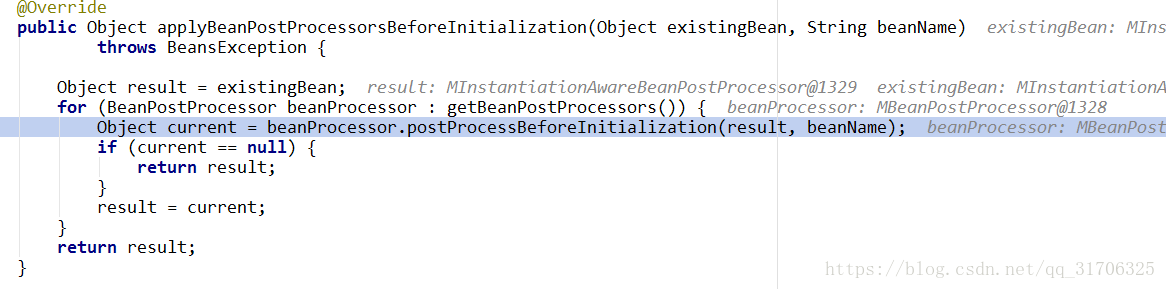
向上找调用者:

继续向上:

看以看出populateBean(初始化bean)-------------------》beanpostBeforeInitialization---------------------------------->invokeinitMethods(配置的init-method)
postProcessAfterInitialization调用时机: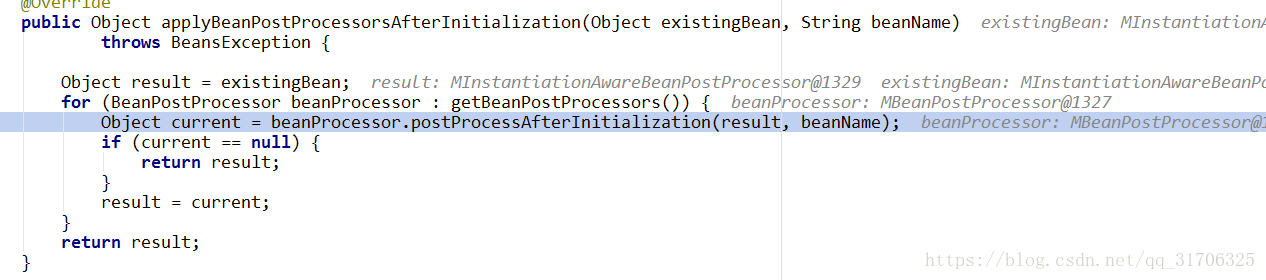
向上:
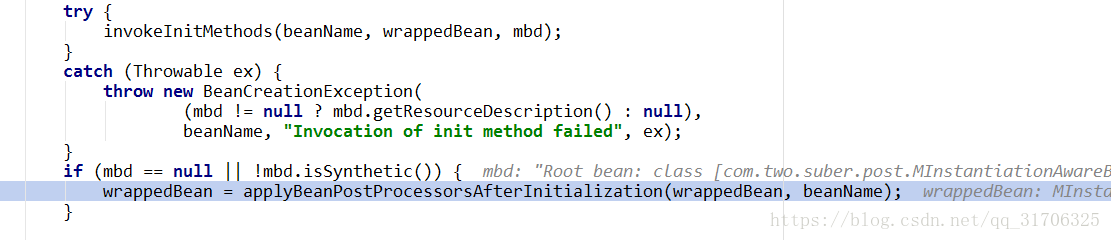
可以看出在init-method方法之后
看以看出populateBean(初始化bean)-------------------》beanpostBeforeInitialization---------------------------------->invokeinitMethods(配置的init-method)------->postProcessAfterInitialization
public class MBeanPostProcessor implements BeanPostProcessor { @Override //populateBean之后 invokeinitMethods之前 public Object postProcessBeforeInitialization(Object bean, String beanName) throws BeansException {System.out.println('post bean before! :'+beanName);return bean; } @Override //invokeinitMethods之后 public Object postProcessAfterInitialization(Object bean, String beanName) throws BeansException {System.out.println('post bean after!'+beanName);return bean; }}
另一个重要的是:
InstantiationAwareBeanPostProcessor
postProcessBeforeInstantiation调用时机:
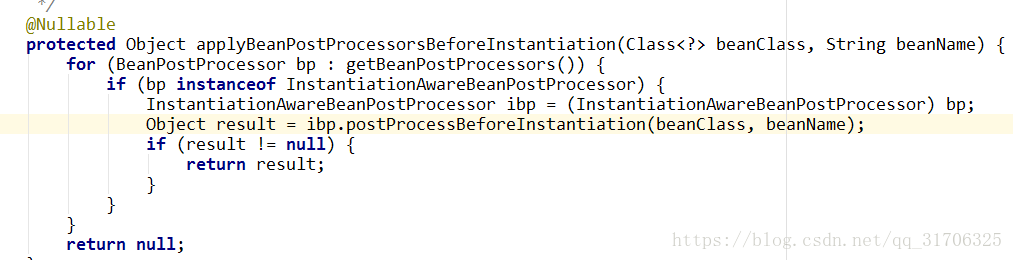
向上找调用者:
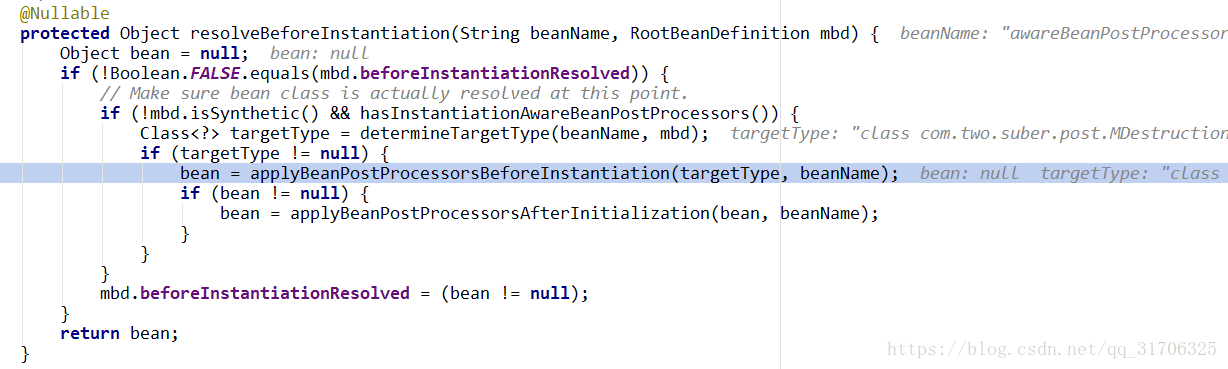
继续向上:
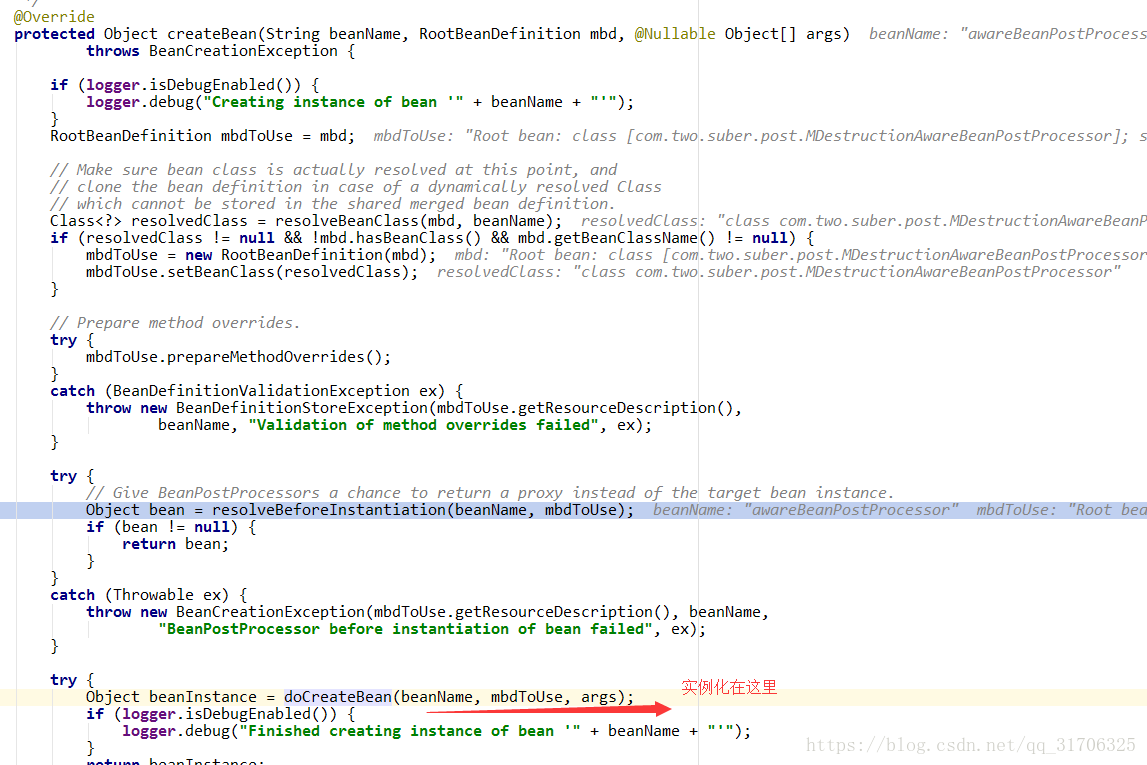
可以看出是在实例化之前:(也就是反射创建对象之前,如果postProcessBeforeInstantiation创建了一个非空的对象,则不会走实例化步骤。)
postProcessAfterInstantiation调用时机:
protected void populateBean(String beanName, RootBeanDefinition mbd, @Nullable BeanWrapper bw) { PropertyValues pvs = mbd.getPropertyValues(); if (bw == null) { if (!pvs.isEmpty()) { throw new BeanCreationException( mbd.getResourceDescription(), beanName, 'Cannot apply property values to null instance'); } else { // Skip property population phase for null instance. return; } } // Give any InstantiationAwareBeanPostProcessors the opportunity to modify the // state of the bean before properties are set. This can be used, for example, // to support styles of field injection. boolean continueWithPropertyPopulation = true; if (!mbd.isSynthetic() && hasInstantiationAwareBeanPostProcessors()) { for (BeanPostProcessor bp : getBeanPostProcessors()) { if (bp instanceof InstantiationAwareBeanPostProcessor) { InstantiationAwareBeanPostProcessor ibp = (InstantiationAwareBeanPostProcessor) bp; //在这里执行 if (!ibp.postProcessAfterInstantiation(bw.getWrappedInstance(), beanName)) { continueWithPropertyPopulation = false; break; } } } } if (!continueWithPropertyPopulation) { return; } 省略。。。。。 applyPropertyValues(beanName, mbd, bw, pvs);}
可以看出是在在初始化之前,具体是属性填充之前。(初始化之前,实例化之后) 如果返回fales,则不会继续初始化,即不会属性填充。
postProcessPropertyValues调用时机:
protected void populateBean(String beanName, RootBeanDefinition mbd, @Nullable BeanWrapper bw) { PropertyValues pvs = mbd.getPropertyValues(); if (bw == null) { if (!pvs.isEmpty()) { throw new BeanCreationException( mbd.getResourceDescription(), beanName, 'Cannot apply property values to null instance'); } else { // Skip property population phase for null instance. return; } } // Give any InstantiationAwareBeanPostProcessors the opportunity to modify the // state of the bean before properties are set. This can be used, for example, // to support styles of field injection. boolean continueWithPropertyPopulation = true; if (!mbd.isSynthetic() && hasInstantiationAwareBeanPostProcessors()) { for (BeanPostProcessor bp : getBeanPostProcessors()) { if (bp instanceof InstantiationAwareBeanPostProcessor) { InstantiationAwareBeanPostProcessor ibp = (InstantiationAwareBeanPostProcessor) bp; if (!ibp.postProcessAfterInstantiation(bw.getWrappedInstance(), beanName)) { continueWithPropertyPopulation = false; break; } } } } if (!continueWithPropertyPopulation) { return; } if (mbd.getResolvedAutowireMode() == RootBeanDefinition.AUTOWIRE_BY_NAME || mbd.getResolvedAutowireMode() == RootBeanDefinition.AUTOWIRE_BY_TYPE) { MutablePropertyValues newPvs = new MutablePropertyValues(pvs); // Add property values based on autowire by name if applicable. if (mbd.getResolvedAutowireMode() == RootBeanDefinition.AUTOWIRE_BY_NAME) { autowireByName(beanName, mbd, bw, newPvs); } // Add property values based on autowire by type if applicable. if (mbd.getResolvedAutowireMode() == RootBeanDefinition.AUTOWIRE_BY_TYPE) { autowireByType(beanName, mbd, bw, newPvs); } pvs = newPvs; } boolean hasInstAwareBpps = hasInstantiationAwareBeanPostProcessors(); boolean needsDepCheck = (mbd.getDependencyCheck() != RootBeanDefinition.DEPENDENCY_CHECK_NONE); if (hasInstAwareBpps || needsDepCheck) { PropertyDescriptor[] filteredPds = filterPropertyDescriptorsForDependencyCheck(bw, mbd.allowCaching); if (hasInstAwareBpps) { for (BeanPostProcessor bp : getBeanPostProcessors()) { if (bp instanceof InstantiationAwareBeanPostProcessor) { InstantiationAwareBeanPostProcessor ibp = (InstantiationAwareBeanPostProcessor) bp; pvs = ibp.postProcessPropertyValues(pvs, filteredPds, bw.getWrappedInstance(), beanName); if (pvs == null) { return; } } } } if (needsDepCheck) { checkDependencies(beanName, mbd, filteredPds, pvs); } } applyPropertyValues(beanName, mbd, bw, pvs);}
在postProcessAfterInstantiation之后,applyPropertyValues之前。(属性填充之前修改属性值)
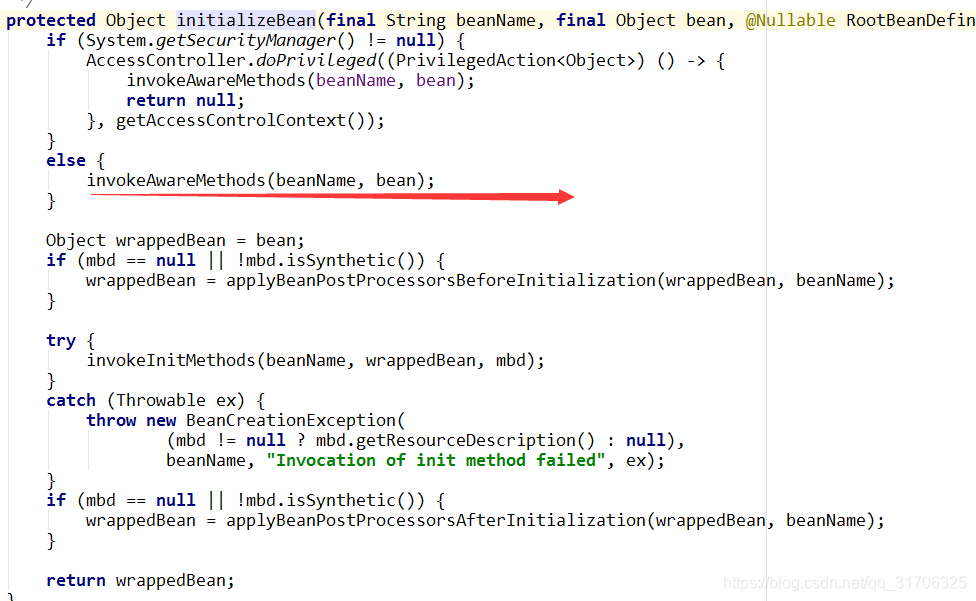
总结: 执行顺序 1.postProcessBeforeInstantiation(实现这个方法可以做自定义实例化) 2.实例化 3.postProcessAfterInstantiation(是否要初始化) 4.postProcessPropertyValues(修改属性) 5.初始化(属性填充)(populateBean) 6.postProcesstBeforeInitialization( 自定义init方法执行之前) 7.invokeinitMethods(执行自定义的init方法) 8.postProcessAfterInitialization(自定义init方法执行之后)如果加上aware
以上为个人经验,希望能给大家一个参考,也希望大家多多支持好吧啦网。
相关文章:

 网公网安备
网公网安备